ALPR Parking Time Service
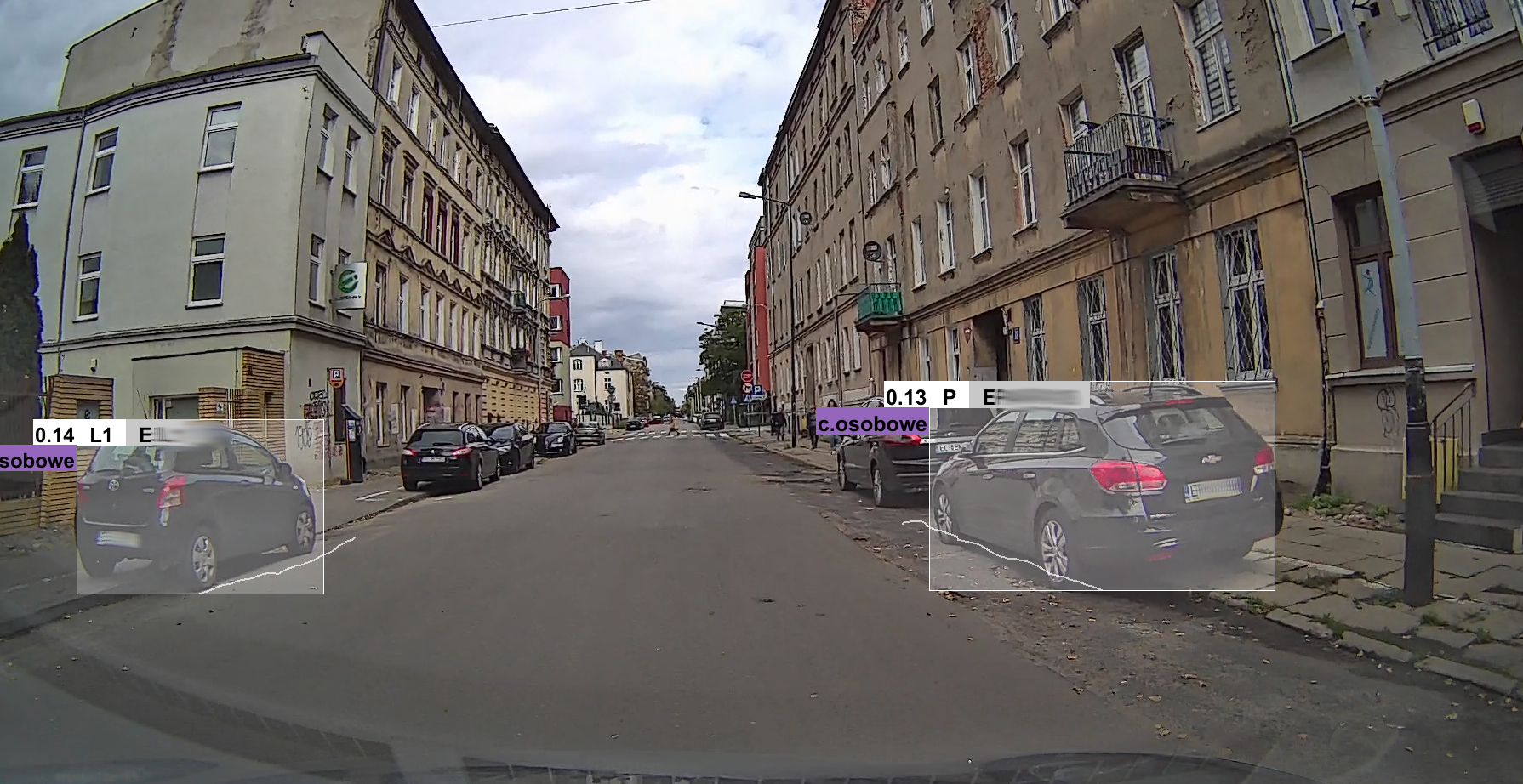
The ALPR Parking Time service is designed for mobile camera systems mounted inside or outside a moving vehicle. It monitors parking zones, enforces parking-time limits, and tracks vehicle presence by repeatedly scanning and recognizing registration plates while travelling through designated areas.
Use cases
- Parking-zone enforcement — monitor how long vehicles remain in paid zones.
- Car-park management — track vehicle entry, exit, and duration of stay.
- On-street parking surveys — survey parked vehicles along a route.
- Time-limited parking monitoring — detect overstays in restricted areas.
Camera requirements
Vehicle-mounted cameras
Cameras installed behind the windscreen or on the vehicle roof scan parked vehicles while driving.
Video requirements:
- frame rate: 50–60 FPS,
- resolution: Full HD, 1920×1080, or higher,
- survey-vehicle speed: below 30 km/h for reliable recognition,
- a wide field of view is recommended for vehicles parked beside the route.
Why is a high frame rate required?
- A moving camera and stationary plates create a motion-blur risk.
- A higher frame rate provides more frames for each vehicle.
- It increases the chance of capturing a sharp, readable plate image.
Mounting considerations:
- Use a stable mount to minimize vibration.
- Use anti-glare filters when recording through a windscreen.
- Consider several cameras to cover both sides of the vehicle.
Generated reports and data
The service provides specialized reports for parking analysis.
Output files
| File | Description |
|---|---|
History.csv |
Complete scan history with timestamps |
Alpr.csv |
All registration readings with metadata |
AlprOccurences.csv |
Registration occurrence matrix by time interval |
AlprParktime.csv |
Parking-time analysis for each vehicle |
Alpr0to500.xlsx, ... |
Paginated Excel workbooks with images |
Parking-duration estimate
AlprParktime.csv contains estimates based on the first and last observations of the same plate:
| Field | Description |
|---|---|
| Registration | Recognized registration text |
| Start | Timestamp of the first observation |
| End | Timestamp of the last observation |
| Duration | Difference between the first and last observations in minutes |
By default, data is grouped into five-minute intervals and sorted by duration, longest first.
The result assumes that the vehicle remained parked between observations. It cannot rule out departure and return between patrol passes, and it does not identify the exact arrival or departure time. Estimate precision depends on the interval between passes. A single observation confirms presence only at that time; observations separated by a long gap should be treated as separate sessions.
Data fields
Every registration observation contains:
| Field | Description |
|---|---|
ALPR |
Recognized registration text |
ALPR_score |
Recognition confidence from 0.0 to 1.0 |
ALPR_type |
Registration-plate type classification |
ALPR_region |
Region or country code |
ALPR_lettercode |
District or city letter code |
Czas |
Observation timestamp |
Image |
Path to the vehicle image |
ALPR_image |
Path to the cropped registration image |
Occurrence matrix
AlprOccurences.csv is a time-based matrix showing when each registration was observed:
| Time | ABC1234 | XYZ5678 | ... |
|---|---|---|---|
| 08:00 | 1 | 0 | ... |
| 08:05 | 1 | 1 | ... |
| 08:10 | 0 | 1 | ... |
This matrix helps visualize vehicle-presence patterns over time.
Using ALPR_score to verify a reading
- High score, 0.9 or above: a high-confidence plate reading useful for permit matching.
- Medium score, 0.5–0.9: suitable for audit trails; flag it for manual review if exact matching fails.
- Low score, below 0.5: do not use it for enforcement without manual verification.
ALPR_score measures confidence in the recognized plate text. It does not prove that the vehicle remained parked continuously between observations.
Example workflow
- Plan the route through the parking zone.
- Collect data by driving the route with the camera recording, repeating it at the required interval.
- Process the video with AITracker's ALPR service.
- Calculate parking time by correlating the same registrations across passes.
- Export an enforcement report containing vehicles that exceeded the time limit.
Accuracy
| Factor | Effect on accuracy |
|---|---|
| Vehicle speed below 30 km/h | Optimal |
| Vehicle speed from 30–50 km/h | Reduced accuracy |
| Night operation | Requires an IR camera |
| Angle to parked vehicles | 15–45° is optimal |
Overall ALPR accuracy is approximately 90% in optimal conditions.
Processing speed is approximately 1–2 times real time for 50–60 FPS video.
Limitations
- GPS integration: only timestamps are currently used; GPS correlation requires external tools.
- Multiple passes: parking-time calculation requires repeated passes along the route.
- Plate visibility: obscured or dirty plates may not be recognized.
- Parking continuity: the first and last observations do not prove uninterrupted parking between them.
- Pass interval: arrival and departure precision is limited by patrol frequency.