ALPR Traffic Counting Service
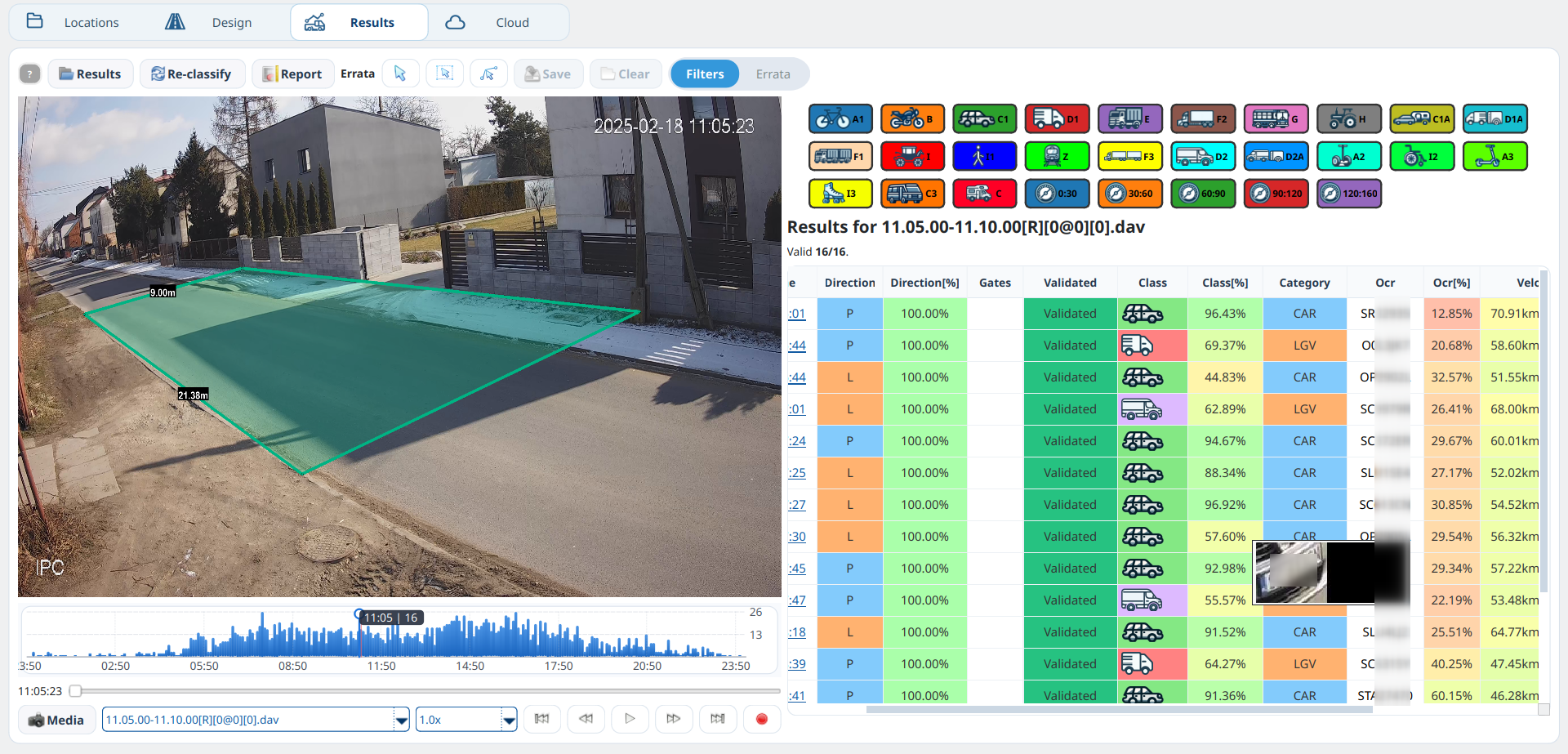
The ALPR Traffic service combines traditional traffic counting with Automatic License Plate Recognition (ALPR). For each counted vehicle crossing your measurement cross-sections, the system captures and recognizes the license plate, providing detailed vehicle identification alongside traffic statistics.
Use Cases
- Origin-Destination (O-D) studies - Track vehicles between multiple measurement points
- Fleet monitoring - Track specific vehicle groups through measurement zones
- Border crossing analysis - Document vehicle movements between regions
Camera Requirements
The standard camera and mounting requirements described in Choosing a Camera and Mounting a Camera apply, together with the additional ALPR requirements below.
Daytime requirements: - Video frame rate: 25–60 FPS. - Optimal angle: 15–45° to the road surface.
Nighttime requirements: - A narrow-beam 850 nm IR illuminator, with an approximately 15–30° beam, mounted close to the camera axis with 10–30 cm separation. - Manual shutter speed: target 1/2000 s, minimum 1/1000 s, to eliminate motion blur under IR illumination. - A 2 MP varifocal camera, which performs better than 4K in low light because of larger pixels and less noise. - A black-and-white night profile with DNR, WDR, and BLC disabled because these filters reduce sharpness under IR. - Camera horizontal angle no greater than 20–30° and vertical angle no greater than 30°, so the plate is viewed close to head-on. - Illuminator power sufficient for a 15–20 m reading distance.
Note: Night ALPR is a measurement system consisting of the camera, IR illuminator, mounting, and configuration—not merely an application feature. Failed nighttime readings are almost always caused by hardware or optics rather than the algorithm. Contact us for a professional assessment and configuration guidance. The estimated gross cost of a complete night setup is approximately PLN 1,500.
Generated Reports and Data
The ALPR Traffic service produces comprehensive reports combining traffic counting with license plate recognition data.
Output Files
| File | Description |
|---|---|
History.csv |
Complete vehicle history with all data fields |
Alpr.csv |
Filtered ALPR-specific data |
Alpr0to500.xlsx, Alpr500to1000.xlsx, ... |
Excel sheets with vehicle images and license plate crops (paginated for large datasets) |
AlprOccurences.csv |
License plate occurrence matrix grouped by time intervals |
Quantity.csv |
Standard traffic counting results |
Report.docx |
Generated measurement report |
Data Fields
Each recognized vehicle record contains:
| Field | Description |
|---|---|
ALPR |
Recognized license plate text |
ALPR_score |
Recognition confidence (0.0 - 1.0) |
ALPR_type |
License plate type classification |
ALPR_region |
Region/country code (e.g., "PL", "DE") |
ALPR_lettercode |
District/city letter code (e.g., "WA" for Warsaw) |
ALPR_image |
Cropped license plate image path |
Image |
Full vehicle image path |
Recognition Statistics
The system calculates ALPR totals for quality assessment:
| Metric | Description |
|---|---|
| Total vehicles | All counted vehicles in measurement |
| ALPR detected | Vehicles with license plates detected |
| ALPR read | Vehicles with successfully read plates |
| Region recognized | Plates with identified region codes |
| Letter code recognized | Plates with identified district codes |
Polish License Plate Recognition Details
Polish standard license plate format: XX YYYYY or XX 123AB
- First 2 characters: Region/district code (e.g., "WA" for Warsaw, "GD" for Gdańsk)
- Remaining characters: Vehicle registration number
Common Polish region codes (ALPR_lettercode):
| Code | Region | Code | Region | Code | Region |
|---|---|---|---|---|---|
| BA | Białystok | PZ | Poznań | TO | Tarnów |
| BN | Bielsko-Biała | RZ | Rzeszów | WA | Warsaw |
| DS | Dolnośląskie (Wrocław) | SL | Silesian (Katowice) | WR | Wrocław |
| GD | Gdańsk | SZ | Szczecin | WN | Włocławek |
| GO | Gorzów | SK | Świętokrzyskie | ZG | Zielona Góra |
| KA | Kalisz | PM | Pomeranian | ||
| KI | Kielce | KR | Kraków | ||
| KO | Koszalin | LD | Łódź | ||
| LE | Legnica | LU | Lublin |
Plate type classifications (ALPR_type):
- STANDARD - Regular vehicle plates (white background)
- EU - EU format with country symbol
- COMMERCIAL - Yellow plates (taxis, rental vehicles)
- AGRICULTURAL - Green plates (farm vehicles)
- DIPLOMATIC - Special format (embassies, international organizations)
- TRANSIT - Temporary transit plates (red border)
Understanding ALPR_score in Polish context:
- 0.95-1.0 = Excellent read (new, clean plates)
- 0.85-0.95 = Good read (standard conditions)
- 0.75-0.85 = Acceptable (typical Polish plates, some wear)
- 0.60-0.75 = Marginal (dirty, faded, or obscured)
- < 0.60 = Poor read (manual verification recommended)
Excel Reports with Images
For detailed analysis, the system generates Excel files containing:
- Vehicle thumbnails in the
Imagecolumn - Cropped license plate images in the
ALPR_imagecolumn - All metadata fields for filtering and analysis
Note: Excel files are paginated (default 500 rows per file) to ensure stability with large datasets.
Accuracy
| Condition | Expected Accuracy |
|---|---|
| Daytime, clear view | 85–95% |
| Rain or snow | 80% |
| Dirty plates | 50% |
| Night with IR and correct hardware configuration | 50% |
| Night without IR or with unsuitable hardware | below 10% |
Overall measurement error (including traffic counting): ~10%
Night ALPR
AITracker capabilities at night
- Transparent performance reporting — AITracker automatically generates 24-hour recognition charts showing actual performance for every hour. Failed reads are reported rather than hidden.
- Data for tender calculations — nighttime traffic statistics, typically 8–15% of daily traffic, help justify measurement tolerances in tender documents.
- Read-quality reporting — the ALPR report exposes recognition precision, plate types, regions, and letter codes; verify plate size and camera settings during installation.
- Camera configuration — configure exposure, night mode, and IR filters on the camera itself; AITracker does not control these settings.
Technical limitations
- Missing input cannot be reconstructed — if the image is blurred, overexposed, or lacks plate retroreflection, there is no information for the algorithm to read.
- Night ALPR is usually not an algorithm problem — unsuccessful reads are generally caused by unsuitable hardware, such as a wide-angle IR illuminator, a small-pixel camera, enabled DNR/WDR filters, or incorrect mounting.
- Software cannot compensate for unsuitable hardware — a weak camera, inappropriate IR illuminator, or incorrect angle must be corrected in the physical installation.
“The problem is in the optics and hardware, not in the algorithm.” — Sławomir Paszko, AISP
Hardware requirements for night ALPR
Camera
| Parameter | Requirement |
|---|---|
| Shutter | Manual; target 1/2000 s, minimum 1/1000 s |
| Resolution | 2 MP varifocal, preferred to 4K in low light |
| Night mode | Black and white; DNR, WDR, and BLC disabled |
IR illumination
| Parameter | Requirement |
|---|---|
| Wavelength | 850 nm |
| Beam angle | Narrow, approximately 15–30° |
| Distance from camera axis | 10–30 cm |
| Effective range | At least 15–20 m |
Camera mounting
| Parameter | Requirement |
|---|---|
| Horizontal angle | No greater than 20–30° to the path of travel |
| Vertical angle | No greater than 30° |
| Position | Close to head-on to the path of travel, not at a large lateral angle |